Wheel 101 · Part 3
Step 2: How to sell a covered call
Now you own 100 shares. Time to get paid again.
A call is the opposite promise. When you sell one, you're saying: "I'll sell my 100 shares at $Y if the price rises above $Y before a certain date."
It's "covered" because you already own the shares you'd be selling. You can't be forced to buy anything, and no borrowing is involved.
Continuing the example
Same made-up stock from Step 1.
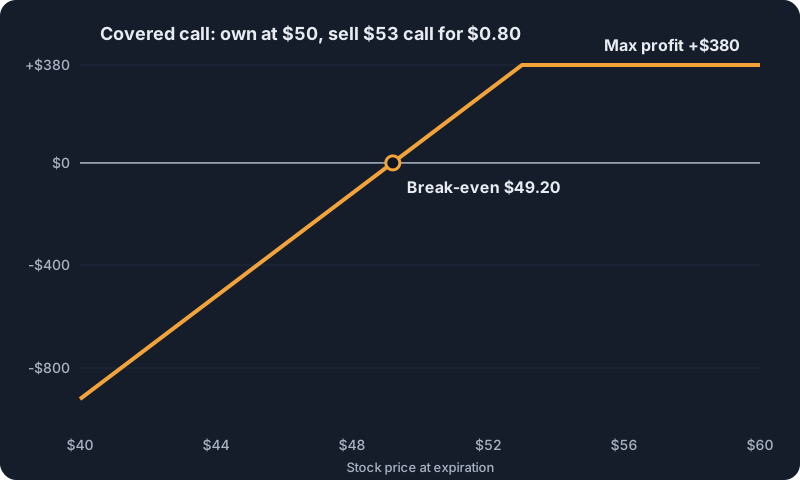
- You own 100 XYZ at $50 (you got assigned on your put).
- You sell a call at $53 that expires in 30 days.
- You get paid $0.80 per share = $80.
Two things can happen
XYZ stays below $53
You keep the $80 and your shares. Sell another call.
XYZ rises above $53
Your shares get sold at $53. You keep the $80 plus a $3/share gain ($300).
Then you're back to cash and back to Step 1. The wheel turns.
One full trip around the wheel
- Put premium: $100
- Call premium: $80
- Gain on the shares ($50 → $53): $300
- Total: $480 on about $5,000 of cash over roughly two months.
Real trips aren't always this clean. Sometimes you sell three or four calls before the shares get called away. Each one still pays you. Sometimes the stock drops and you wait a long time. That's covered in Part 4.
How to sell a covered call, step by step
- Make sure you own at least 100 shares. One contract covers exactly 100.
- Open the options chain for that stock.
- Choose an expiration date. Like puts, many wheel traders look about 30 to 45 days out.
- Switch to the calls side and pick a strike above what you paid. Ask yourself: "Would I be happy selling my shares at this price?"
- Choose "Sell to open." Your broker should show it as a covered call.
- Quantity: 1 contract per 100 shares.
- Use a limit order near the middle of the bid and ask, then submit.
The premium hits your account right away, same as with puts.
How to pick a call strike
- Start with your cost. Your cost per share is what you paid minus the premiums you've already collected on that stock. Selling a call below that can lock in a loss if the shares get called away.
- Pick a price you'd be glad to sell at. If getting called away at that price would annoy you, go higher.
- Closer strikes pay more but cap your upside sooner. Further strikes pay less but let the stock run more.
- Check for earnings and dividends before the expiration date (more below).
What does "called away" mean?
If the stock is above your call strike at expiration, your broker sells your 100 shares at the strike price. That's being called away. The cash lands in your account, you keep the premium, and you're back at the start of the wheel, ready to sell a new put.
It can happen early too, most often right before a stock pays a dividend. If that happens, you just lose out on that dividend. You still get the strike price for your shares.
What if the stock drops after you buy it?
This is the hard part of the wheel. Say XYZ falls to $44 after you were assigned at $50. A call at $50 or higher might only pay a few cents now.
Your choices:
- Sell calls at or above your cost even if they pay less, and keep collecting while you wait for a recovery.
- Wait for a bounce before selling the next call, so you get paid more for the same strike.
- Hold the shares and collect any dividend if you still believe in the company.
What you shouldn't do is sell a call far below your cost just because it pays more. If the stock bounces, you could be forced to sell at a loss. I'm in exactly this spot with one stock right now, and I share how I'm handling it in Part 4.
What if the stock shoots up?
If XYZ jumps to $65, your shares still get sold at $53. You keep your $80 and the $300 gain, but you miss the rest of the move. That's the trade you make for getting paid upfront.
If you really want to keep the shares, you can roll the call: buy it back and sell a new one further out at a higher strike. Many wheel traders simply let the shares go and start the wheel again on the next put.
Covered calls and dividends
While you own the shares, you still collect any dividends the company pays. That's a small bonus on top of call premium. In my real META trade, I collected a small dividend while I held the shares.
Questions beginners ask
Can you lose money on a covered call?
Yes, but the call isn't what hurts you. The risk is in the shares. If the stock drops below your cost minus the premiums you've collected, you're down. The call premium only softens the drop.
What happens if my covered call expires worthless?
That's a good outcome. The stock stayed below your strike, you keep the full premium and your shares, and you can sell another call.
Can I sell a covered call with less than 100 shares?
No. One standard contract covers 100 shares. With 50 shares you'd have to buy 50 more first.
Should I sell covered calls on a stock I want to keep forever?
Be careful. Any covered call can lead to your shares being sold. If you'd hate to lose a stock, either pick strikes far above the price or don't sell calls on it.