Wheel 101 · Part 2
Step 1: How to sell a cash-secured put
A put is a contract. When you sell one, you're making a promise: "I'll buy 100 shares of this stock at $X if the price drops below $X before a certain date."
For making that promise, someone pays you cash right away. That cash is called premium. It's yours to keep no matter what.
"Cash-secured" means you keep enough cash in your account to actually buy the 100 shares if needed. No borrowing, no surprises.
A simple example
Made-up numbers to keep it easy.
- Stock XYZ trades at $52.
- You sell a put at $50 that expires in 30 days.
- You get paid $1.00 per share = $100 (one contract = 100 shares).
- You keep $5,000 set aside in case you have to buy.
Two things can happen
XYZ stays above $50
The contract expires. You keep the $100 and do it again.
XYZ drops below $50
You buy 100 shares at $50. You still keep the $100. That's called being assigned.
Being assigned isn't failure. It's just Step 2.
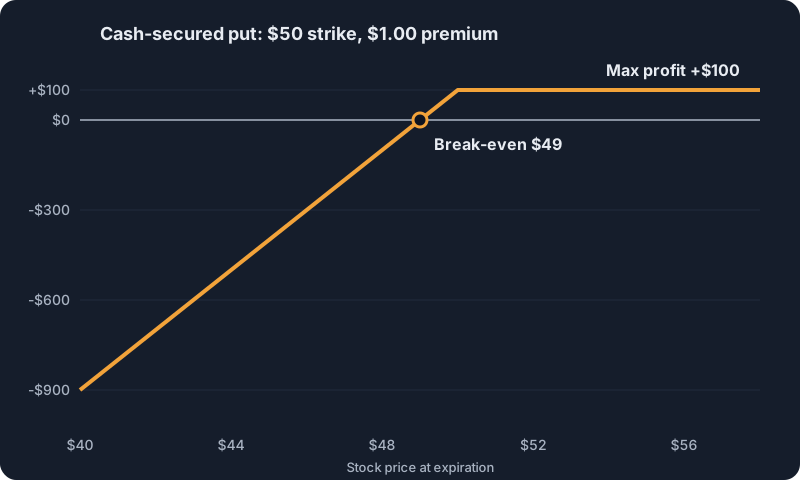
The math that matters
- Most you can make: the $100 premium.
- Break-even: $50 strike − $1 premium = $49. If you get assigned, that's your real cost per share.
- Return on cash: $100 ÷ $5,000 = 2% for 30 days. That's why the wheel is about steady singles, not home runs.
- Real risk: if XYZ falls to $40, your shares are worth $4,000 but cost you $4,900 after premium. You're down $900 on paper. Same as owning the stock, just a little better.
How to sell a cash-secured put, step by step
Every broker's screen looks a little different, but the steps are the same:
- Pick a stock you'd happily own. This is the most important step. If you wouldn't buy it today, don't sell a put on it.
- Open the options chain. It's usually a tab called "Options" or "Trade options" on the stock's page.
- Choose an expiration date. Many wheel traders pick something about 30 to 45 days out. Shorter dates pay less each time but need more attention.
- Switch to the puts side and pick a strike below today's price. Ask yourself: "Would I be glad to buy 100 shares at this price?"
- Choose "Sell to open." Not "buy." You're the one getting paid.
- Quantity: 1 contract (100 shares). Start small.
- Use a limit order near the middle of the bid and ask prices. That's the price you get paid per share.
- Check the cash requirement on the review screen. It should be roughly strike × 100, minus the premium. Then submit.
The premium shows up in your account right away. Now you wait.
How to pick a strike price
Three simple checks help:
- Would you buy it there? Pick a price that feels like a fair or good deal for the business.
- How far below today's price is it? Closer strikes pay more but get assigned more often. Further strikes pay less but give the stock room to dip.
- What does delta say? Delta is a rough guess of the chance you'll be assigned. A 0.20 delta put is roughly a 20% chance. Lower delta, lower premium, less likely to be assigned. (More in Part 5.)
Also watch the calendar. Earnings reports can move a stock a lot overnight. Bigger premium right before earnings usually means bigger risk.
What happens when a cash-secured put gets assigned
This is the part that scares beginners most, so here's exactly what happens:
- Expiration day arrives with the stock below your strike.
- Your broker buys 100 shares for you at the strike price, using the cash you set aside. In our example, $5,000 leaves your account.
- The shares show up in your account, usually by the next morning.
- You still keep the premium. Your real cost is $49 a share, not $50.
Assignment can also happen before expiration, but it's less common. It usually happens when the stock is well below your strike. Either way, it's the same outcome: you own the shares at the price you agreed to.
Once you own the shares, you move to Step 2: selling a covered call.
What if the stock drops a lot?
Say XYZ falls from $52 to $42 before expiration. You'll be assigned at $50, and you'll be down about $700 on paper right away ($49 cost vs. $42 price).
You have a few choices:
- Take the shares and start selling calls above your cost while you wait. This is the normal wheel path.
- Roll the put before expiration. That means buying back the current put and selling a new one further out in time, often at a lower strike. It buys time, but it isn't a free fix.
- Close the put for a loss if your view of the company changed. Owning a stock you no longer believe in is worse than a small loss.
This is exactly why rule #1 is "only stocks you'd happily own for years." See how I handle one of these in Part 4.
Closing a put early
You don't have to wait until expiration. If the put you sold for $1.00 is now worth $0.50, you can buy it back and lock in $50 of profit. That frees your cash to sell a new put. I set a 50% take-profit order on most trades for this reason.
Questions beginners ask
Can you lose money selling a cash-secured put?
Yes. If the stock falls below your break-even (strike minus premium), you lose money on the shares you buy. The most you can lose is if the stock went to zero: the strike times 100, minus the premium.
Is it bad to get assigned on a put?
Not if you picked a stock you wanted. Assignment is the normal next step of the wheel. It only hurts when the stock keeps falling or you didn't want to own it.
When do you get paid for selling a put?
Right away. The premium lands in your account when the order fills, and it's yours to keep whether you get assigned or not.
Do I need margin to sell cash-secured puts?
No. A cash-secured put is fully covered by cash in your account, so it works in a regular cash account and in many retirement accounts.